
Software development has evolved dramatically over the last decade. Agile methodologies, DevOps practices, and continuous delivery pipelines have enabled organizations to release software faster than ever before. However, traditional testing approaches have struggled to keep pace with this acceleration.
This is where AI-powered test automation is changing the game. By combining artificial intelligence with automated testing, organizations can create, execute, maintain, and optimize tests with significantly less effort while improving quality and release velocity.
In this article, we'll explore what AI-powered test automation is, how it works, its key benefits, and why it is becoming an essential component of modern software quality assurance.
Understanding Traditional Test Automation
Traditional test automation relies on predefined scripts created and maintained by automation engineers. A typical automation workflow includes identifying test scenarios, writing automation scripts, executing test suites, analyzing results, and updating scripts when applications change.
While this approach reduces manual testing effort, it introduces new challenges:
- High script maintenance costs
- Frequent test failures due to UI changes
- Complex setup and onboarding
- Dependence on specialized automation skills
- Difficulty scaling across large applications
As applications become more dynamic, maintaining traditional automation frameworks becomes increasingly expensive and time-consuming.
What Is AI-Powered Test Automation?
AI-powered test automation uses artificial intelligence and machine learning techniques to improve how tests are created, executed, maintained, and optimized. Instead of relying entirely on manually written scripts, AI helps automate many tasks that traditionally required human intervention.
The goal is not simply to automate testing but to make automation itself smarter.
AI-powered testing platforms can:
- Generate test cases automatically
- Detect application changes
- Self-heal broken locators
- Identify high-risk areas
- Recommend test coverage improvements
- Analyze execution results intelligently
- Reduce false positives and flaky tests
How AI-Powered Test Automation Works
1. Intelligent Test Creation
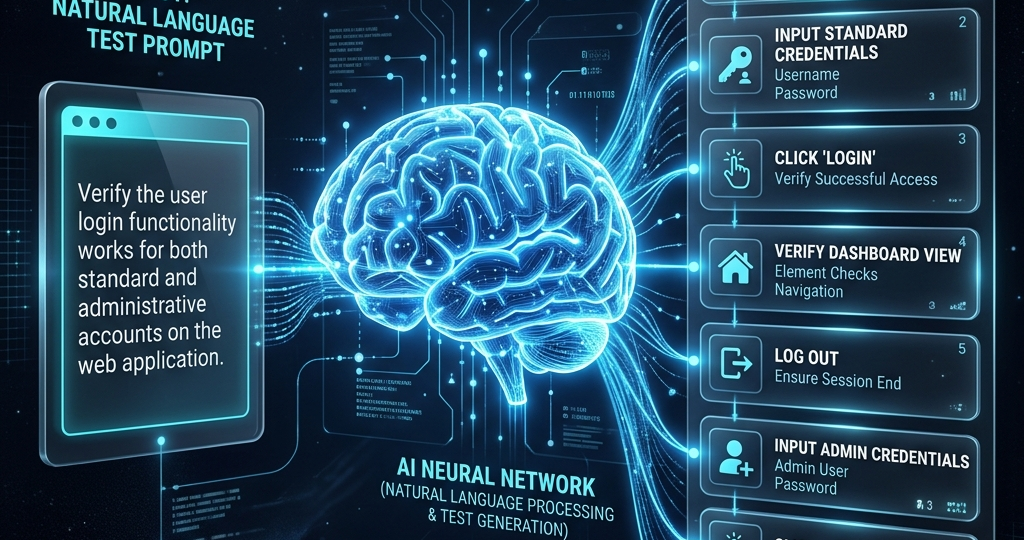
Modern AI testing platforms can generate test scenarios from user stories, requirements documents, application workflows, and recorded user interactions. Instead of writing lengthy scripts, users can describe a workflow in natural language and allow AI to generate automation steps.
Example: "Verify successful login using valid credentials." The platform can automatically create the required steps: open application, enter username, enter password, click login, and verify successful navigation.
2. Self-Healing Automation
One of the biggest problems in traditional automation is locator maintenance. For example, if a button's ID changes from login-btn to btn-login-primary, traditional scripts often fail immediately. AI-powered systems analyze surrounding attributes, labels, and page structures to identify equivalent elements automatically.
Benefits of self-healing include:
- Fewer broken tests
- Reduced maintenance effort
- Higher execution reliability
3. Smart Test Execution
AI can determine which tests should run, which tests are impacted by recent changes, and which tests are most likely to fail. Rather than executing thousands of regression tests unnecessarily, AI prioritizes high-value test cases. This reduces execution time while maintaining quality.
4. Automated Defect Analysis
AI can analyze failed test executions and identify probable causes. Instead of simply reporting "Test Failed," the system can provide insights such as element not found, API response mismatch, environment issue, application defect, or data inconsistency. This significantly reduces debugging effort for QA and engineering teams.
Key Benefits of AI-Powered Test Automation
- Faster Test Creation — AI reduces the time required to build automation scenarios by generating tests automatically or through recording and playback mechanisms.
- Lower Maintenance Costs — Self-healing capabilities minimize script updates when applications change.
- Improved Test Coverage — AI can identify gaps in existing test suites and recommend additional scenarios.
- Faster Release Cycles — Smart test selection allows teams to execute only relevant tests during deployments.
- Better Quality — By reducing flaky tests and improving reliability, organizations gain greater confidence in releases.
- Accessibility for Non-Technical Users — Modern AI-powered platforms enable business analysts, manual testers, and product teams to participate in automation without deep programming knowledge.
Common AI Features in Modern Testing Platforms
- AI Test Generation — Generate automation scenarios from requirements and workflows.
- Natural Language Testing — Create tests using plain English instructions.
- Self-Healing Locators — Automatically recover from UI changes.
- Visual Testing — Detect UI differences using image comparison and computer vision.
- Predictive Analytics — Forecast areas most likely to contain defects.
- Intelligent Assertions — Suggest validation points automatically.
Industries Benefiting from AI Testing
AI-powered automation is being adopted across industries including:
- Healthcare — Testing patient portals, appointment systems, and billing workflows.
- Financial Services — Validating transactions, compliance flows, and customer journeys.
- E-Commerce — Testing checkout, payments, promotions, and user experiences.
- SaaS Products — Supporting rapid release cycles and continuous deployment.
Challenges to Consider
While AI-powered testing offers significant benefits, organizations should consider initial adoption challenges, as teams may require training and process changes. Trust and transparency remain important — users need confidence in AI-generated recommendations. Additionally, AI systems perform best when sufficient testing data is available, and not all AI testing solutions provide the same level of intelligence or maturity.
The Future of Test Automation
The future of testing is moving toward autonomous quality engineering. Instead of spending time writing and maintaining scripts, teams will increasingly focus on defining business requirements, reviewing AI-generated scenarios, monitoring quality metrics, and optimizing user experiences. AI will handle more of the repetitive and technical work associated with automation.
AI-powered test automation is transforming software quality assurance by making testing faster, smarter, and more accessible. Organizations adopting AI-driven testing can reduce maintenance costs, improve release confidence, and accelerate software delivery while empowering both technical and non-technical teams.
As software systems continue to grow in complexity, AI-powered automation is quickly becoming a competitive necessity rather than a future innovation. The question is no longer whether teams should adopt AI in testing — but how quickly they can leverage it to improve quality and speed.